
In 2021, the NC General Assembly and the Governor reached a bipartisan agreement to establish the first carbon emissions reduction goals for the electricity sector by a state in the southeast. This agreement was enacted into law as House Bill 951: Energy Solutions for North Carolina (HB 951). It requires Duke Energy to reduce carbon emissions by 70% from 2005 levels by 2030 and to achieve net-zero emissions by 2050. To reach these statutory requirements, the law directs the NC Utilities Commission (Commission) to develop a plan, otherwise known as the ‘Carbon Plan,’ and to update that plan every two years. The carbon reduction goals can be achieved using technologies such as power generation, transmission and distribution, grid modernization, storage and energy efficiency measures, demand-side management, and the latest technological breakthroughs that meet the least-cost criteria and transitioning away from burning coal and gas for energy.
Stay up to date with information on the Carbon Plan
blog
NCSEA Statement on Duke Energy’s Carbon Plan Supplemental Planning Analysis
Feb 05, 2024
blog
Response to Duke Energy’s Proposed Combined Carbon Plan and Integrated Resources Plan (CPIRP)
Dec 05, 2023
podcast
Episode 107: TotalEnergies – The Carbon Plan & the Future of Offshore Wind in North Carolina
Apr 11, 2024
House Bill 951
House Bill 951 Energy Solutions for North Carolina (HB951) became law in October 2021, marking North Carolina’s largest energy policy milestone since the 2017 enactment of House Bill 589 (HB589). Like HB589, Energy Solutions for North Carolina first emerged from a House-led stakeholder process that took place over months. The bill underwent several iterations in the House before the Senate made further changes to the bill, which largely were the result of negotiations between Senate leadership and the Governor’s office. NCSEA worked with lawmakers and fellow stakeholders from the beginning of the process through the final passage of HB951. This comprehensive bill covered many aspects of the energy industry, including regulatory reform, solar decommissioning, competitive procurement, and coal retirement. However, the most notable provision requires the NC Utilities Commission to take “all reasonable steps” to achieve 70 percent carbons emissions reductions from 2005 levels by 2030 and to achieve carbon neutrality by 2050, codifying the carbon reduction goals outlined in North Carolina’s Clean Energy Plan (Part I Section 1 of HB951). The NCUC is also required to develop, with input from stakeholders and utilities, a Carbon Plan to meet these emission reduction requirements using a least-cost approach. The first Carbon Plan order was issued in December 2022 and will be revisited every two years. A full synopsis of the bill can be found on NCSEA’s HB951 webpage here.
North Carolina Carbon Plan/Integrated Resource Planning Proceeding (CPIRP) (2024)
Background
- September 1, 2023 – Deadline for Duke Energy’s Initial CPIRP Proposal and Direct Testimonies
- May 28, 2024 – Deadline for Intervenors to Review and Respond to Duke’s Plan
- July 1, 2024 – Deadline for Duke to file rebuttal testimony and exhibits of expert witnesses
- July 22, 2024 – Expert witness hearing to review CPIRP intervenor testimonies and proposals begins
- December 31, 2024 – CPIRP order from the Commission due
Duke Energy’s Proposal & Supplemental Filings
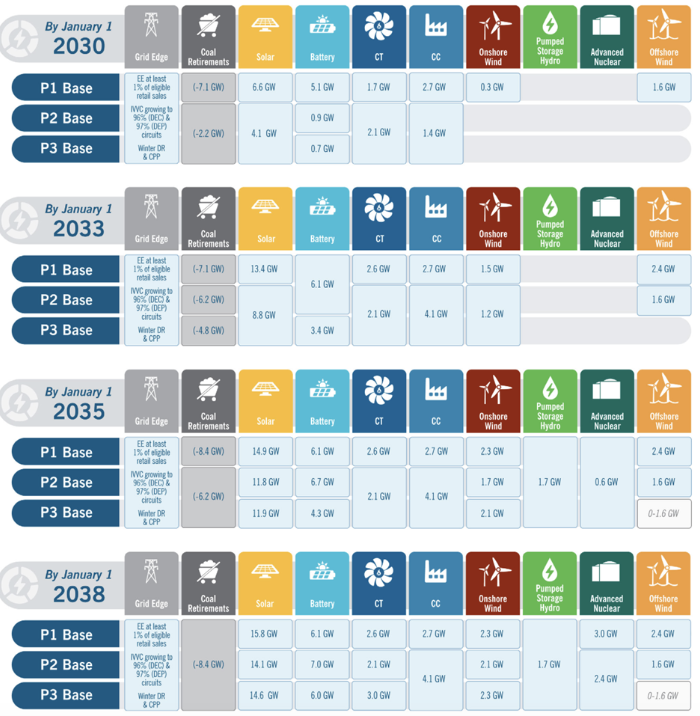
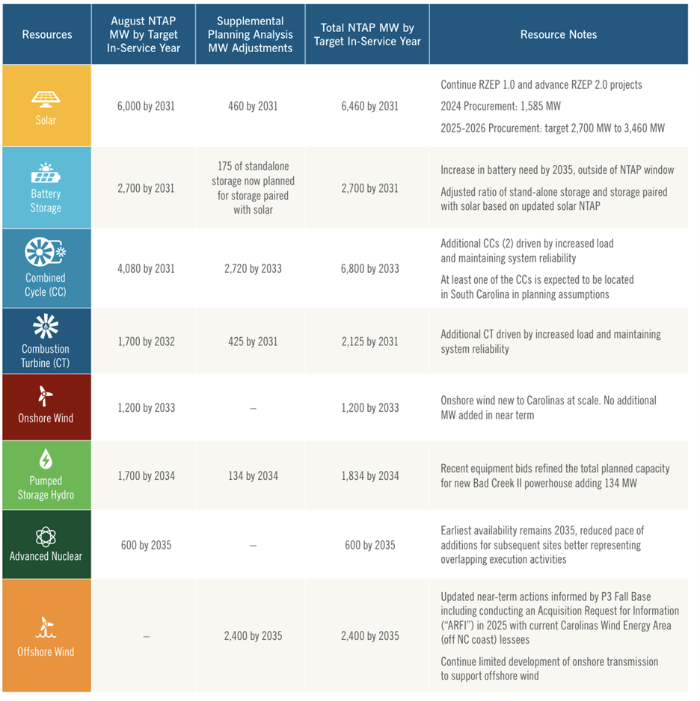
Duke Energy’s supplemental modeling
Intervenors Respond
- Adopt a procedural schedule requiring interim updates from Duke and the wind energy area leaseholders of the Acquisition Request for Information (ARFI) process and its preliminary results in the Fall of 2024. This proposed process will expedite the ARFI process to help accelerate offshore wind deployment and ensure developers can adequately maximize all Inflation Reduction Act incentives.
- Direct Duke and leaseholders to jointly develop procurement schedules for each wind energy area, with achievable milestones through 2032, to achieve, at a minimum, the proposed 2.4 GW of offshore wind generation outlined in Duke’s supplemental filing.
- Authorize early development activities for deployment of offshore wind with approximately $75 million in funding – equivalent to new nuclear resources through 2026. Authorizing these costs will further provide the Commission with more accurate and detailed projected cost estimates needed to assess offshore wind.
- Following the conclusion of the ARFI, convene a separate docket specifically for the purpose of receiving annual updates to track offshore wind procurement and development activities.
- All-of-the-Above – Requiring the review of alternatives that Duke did not sufficiently explore when proposing its significant fossil fuel generation build-out in its CPIRP filings. Duke’s preferred pathway and portfolio solves a transient need by heavily relying on gas combined cycle and combustion turbine generators, but these long-lived assets are likely to become stranded with Duke customers covering their costs for decades while other assets are not being maximized. Accordingly, the Commission should not approve Duke’s preferred pathway and portfolios as they are not representative of a “diverse all-of-the-above resource portfolio.”
- Red Zone Expansion Projects – Approving the additional, proposed Red Zone Expansion Projects while also fully embracing proactive multi-value transmission planning to identify upgrades that not only allow the interconnection of additional renewable resources, but also maximizes reliability, cost-effectiveness, and other transmission benefits to pass through larger net benefits to Duke Customers.
- Interconnection – Increasing, or eliminating, the limits on solar and battery interconnection as they artificially constrain the contributions of cost-effective renewable and storage resources while other solutions to Duke’s interconnection challenges exist.
- Transmission Interconnects – Requiring Duke to plan stronger transmission ties with neighboring utilities, including the merger of Duke Energy Progress and Duke Energy Carolinas, to increase reliability, reduce planning reserve margins, and cost-effectively meeting future needs and carbon reduction requirements.
- Large Customers – Developing a new customer class for customers with energy needs 20 MWs or greater and pathways for this class of customers to serve their energy needs (i.e., self-generation or firm power purchase agreements) while appropriately sharing the costs for system upgrades these large customers are triggering.
- Load Forecast – Directing the Duke to engage professional load forecasters to perform a study with multiple longer-term scenarios about future load increases caused by large customers with energy needs 20 MWs or greater.
- Distributed Resources – Requiring Duke to engage with stakeholders to appropriately analyze and model distributed energy resources (including behind-the-meter storage and electric vehicles) and aggregated distributed energy resources (including Virtual Power Plants with a goal of 300 MW by 2030) in Duke’s long-term resource planning.
- Distribution Plans – Requiring Duke to develop Distribution Resource Plans as part of future CPIRP proceedings.
September 2024 Carbon Plan News:
- E-100 Sub 190 SACE, et al., and NCSEA Joint Post-Hearing Brief and Joint Partial Proposed Order – PUBLIC: NCSEA, along with Southern Environmental Law Center’s clients, Southern Alliance for Clean Energy (SACE), Sierra Club, and Natural Resources Defense Council (NRDC), filed a comprehensive post-hearing brief and joint proposed order summarizing testimonies presented to the Commission in support of requiring Duke Energy to meet the 2030 carbon emissions reduction deadline and investing in more clean energy. The brief covers many issues – too many to summarize here – so please take a look!
- E-100 Sub 190 Post-Hearing Brief of NCSEA in Support of Agreement and Stipulation of Partial Settlement: NCSEA’s post-hearing brief on a proposed partial settlement on large customer programs, demand side management, and reserve margin that NCSEA proposed with Carolina Industrial Group for Fair Utility Rates (CIGFUR), Carolina Utility Customers Association (CUCA) and Clean Energy Buyers Association (CEBA).
- E-100 Sub 190 Partial Proposed Order of CIGFUR, CUCA, CEBA, and NCSEA: This proposed order offers language that the Commission may adopt to advance large customer programs, demand side management, and to keep the current resource reserve margin in place at 17% instead of raising it to 22% as Duke Energy proposed.
2024 Carbon Plan/Integrated Resource Plan Order
- Solar: 3,460 megawatts (MW) of new solar generation, 6,700 MW total by 2031
- Battery: 1,100 MW of battery energy storage, 2,700 MW total by 2031
- Onshore Wind: 1,200 MW of onshore wind in operation by 2033, including at least 300 MW in operation by 2031
North Carolina Carbon Plan Proceeding (2022)
Background and Procedural
Duke Energy’s Proposal

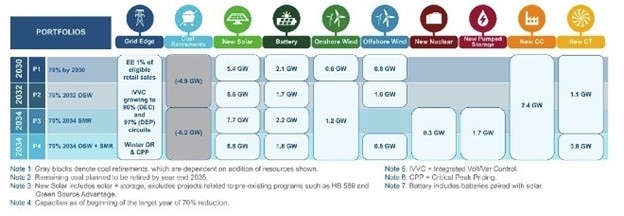
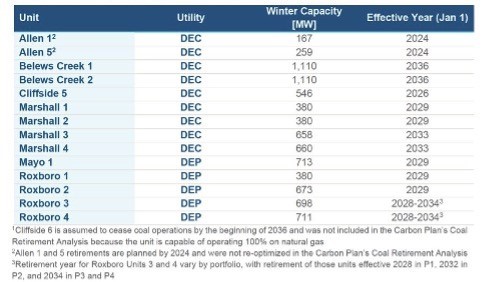
Duke Energy’s filing at the NC Utilities Commission
Intervenors Respond
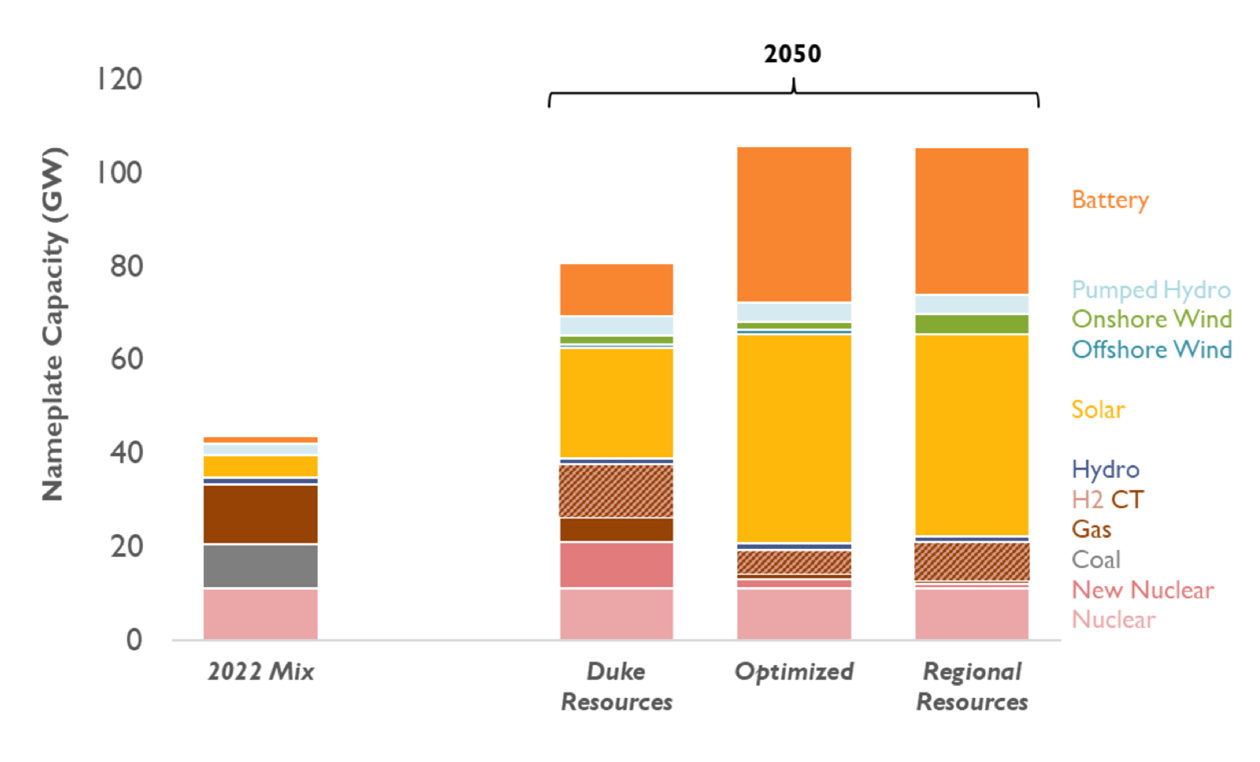
After Duke Energy filed their proposed scenarios on May 16, 2022, clean energy advocates were given 60 days to digest the nearly 900-page document and prepare alternative lower-cost, lower-carbon plans. On July 20, 2022, the North Carolina Sustainable Energy Association, the Southern Environmental Law Center, the Natural Resources Defense Council, the Southern Alliance for Clean Energy, and the Sierra Club jointly filed comments and carbon plan modeling to the Commission. The modeling and analysis filed at the Commission was conducted by Synapse Economics Inc., RMI, and Grid Strategies LLC. The modeling conducted by Synapse using Encompass outlined three scenarios for comparison’s sake:- Duke Resources: Provides a baseline for comparison. This scenario mimics the P1-Alternate scenario proposed in Duke’s carbon plan but uses a revised set of modeling inputs. Note, EnCompass performed a sensitivity to assess the impact of a Regional Greenhouse Gas Initiative (RGGI) on carbon emissions and found that RGGI would cause emission reductions of hundreds of thousands of tons per year in the coming decades, allowing this scenario to meet HB 951 mandates by 2030;
- Optimized: Utilizes Encompass’ economic optimization algorithm to select an economically optimal portfolio of resources, using revised model inputs and making more zero carbon resources available-energy efficiency, renewables, and battery storage; and
- Regional Resources: Allows software to select Midwest wind resources via power purchase agreements through PJM Interconnection.
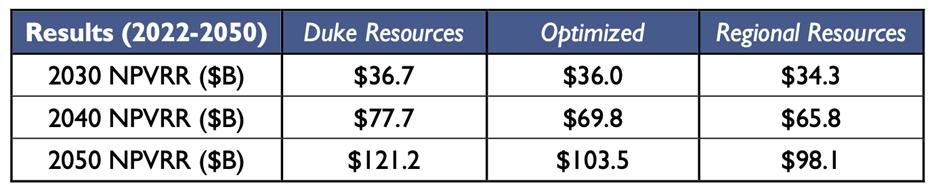
- Cost savings: 2-7% by 2030 and 15-19% by 2050, compared to Duke Resources scenario. This includes NPVRR savings growing from $700 million-$2.4 billion and $17.7-$23.1 billion from 2030 to 2050, respectively;
- No new proposed natural gas: The Synapse scenarios do not select any additional buildout of combined-cycle (CC) or combustion turbine (CT) gas units in its portfolios. There is also less reliance on unproven, uncertain technologies like SMRs and zero-carbon hydrogen availability;
- Increased deployment of proven, scalable renewable energy: Significantly more solar, storage, and wind exist at the core of the Optimized scenario. This portfolio consists of 7.2 GW of solar and 5.6 GW of storage by 2030. By 2040, these figures grow to 22.5 GW of solar, 800 megawatts (MW) of offshore wind, 1.5 GW of onshore wind, and 17 GW of energy storage resources compared to today;
- Earlier retirements of coal and gas: By relying more on cleaner sources of electricity generation, 3.5 GW of coal capacity can be economically retired earlier than in Duke Resources proposal. Furthermore, in the final years of the Synapse planning period, between 800 and 1,300 MW of existing gas resources are economically retired, resulting in the avoidance of expensive utility retrofits to be able to burn hydrogen;
- Energy efficiency easing of grid pressure: The Synapse scenarios include energy efficiency savings of 1.5% of total retail load. Energy efficiency is an achievable, cost-effective pathway for the Duke Energy system to require 2% less energy by 2035 and 5% less energy by 2050, compared to the utility’s baseline assumptions. Energy efficiency alone would save ratepayers in North Carolina billions of dollars by 2050; and
- Collaborative regional purchase agreements: One of the additional scenarios proposed by the CLEAN Intervenors, Regional Resources, underlines the promise of regional coordination and transmission capabilities to provide cost-effective power to North Carolina. This particular portfolio utilizes onshore wind power purchases from the Midwest, allowing the system to procure cost-effective electricity and save ratepayers $1.7 billion by 2030 and $5.4 billion by 2050.
Commission Order
- Coal-fired power plant retirements: The order accepted Duke’s proposed retirement schedule for 8,400-megawatts (MW) of its coal-fired power plants by 2035, with some remaining in operation as late as 2035, as “reasonable for planning purposes.” On top of the unnecessary pollution and carbon emissions created by this prolonged retirement schedule, ratepayers would also bear the risks associated with volatile fuel costs and keeping old, uneconomic coal plants running. On the other hand, earlier coal retirements like proposed in our modeling would avoid expensive utility retrofits, and lead to additional savings associated with securitization, a way of refinancing a portion of the outstanding balance of coal plants that are retired ahead of schedule.
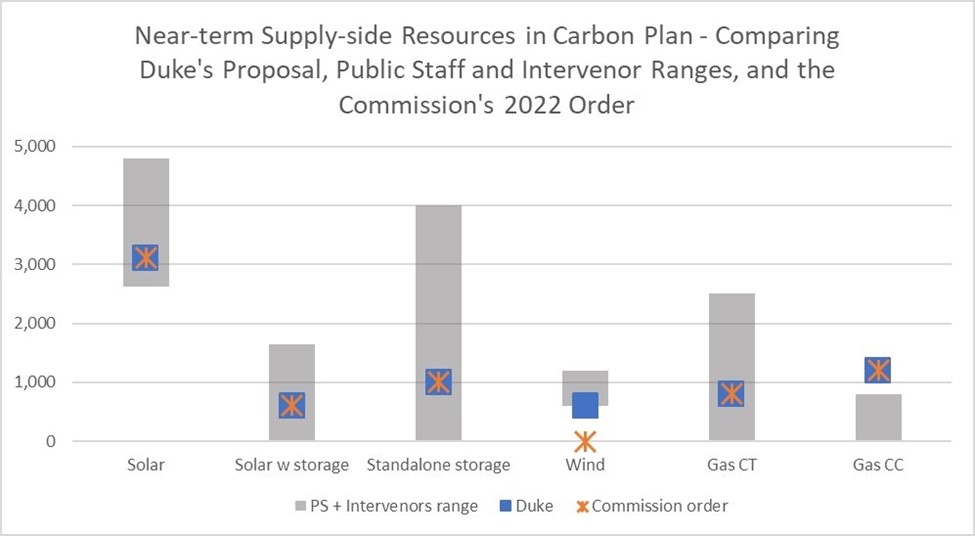
- Natural gas, hydrogen, and nuclear energy: The Commission approved for planning purposes 800 MW of combustion turbine and 1,200 MW of combined cycle gas generation capacity. It also upheld using a 35-year operational life assumption for these new gas plants, with an assumption that green hydrogen fuel will replace gas to offset carbon emissions. It is yet to be determined if this assumption is technologically or financially feasible.
- Renewables:
-
- The Carbon Plan order outlined renewable energy capacity additions that includes 1200 MW of solar procured through the 2022 competitive procurement for renewable energy RFP process (which includes 441 MW that Duke was supposed to procure in 2021 under previous state law), and an additional 2350 MW to be procured in 2023 and 2024.
- Storage: The Carbon Plan states that 1000 MW of standalone battery storage and 600 MW of solar plus storage shall be procured between 2023 to 2024.
- Offshore Wind: The commission ordered an offshore wind study to be conducted by Duke Energy to consider each of the three wind energy areas off the coast of North Carolina, one of which is owned by one of Duke’s unregulated affiliates. The Commission directed that the utility’s study of these lease areas remain unbiased despite Duke Energy Renewables Wind’s ownership of the Carolina Long Bay lease and Duke’s prior argument that it should be allowed to move forward with its affiliate’s lease area.
- Onshore Wind: Duke was ordered to conduct stakeholder engagement sessions to determine viability of onshore wind as soon as practicable and to incorporate those findings into the next iteration of the Carbon Plan.
- Pumped Storage Hydropower: NCUC gave its nod of approval to the proposed Bad Creek pumped storage hydro facility expansion, allowing Duke to spend up to $40 million to add 1700 MW of capacity—effectively doubling this resource’s capabilities.
- Energy efficiency and demand-side management: The Commission approved Duke’s target of 1% eligible load reduction per year for planning purposes, though required the modeling of a 1.5% aspirational efficiency savings goal as part of the next Carbon Plan.
- Proactive transmission planning: 14 red-zone transmission upgrade projects were approved by the Commission. These red-zone areas are locations in need of significant upgrades to interconnect additional solar across the grid in North Carolina. In fact, these upgrades would enable an additional 3000 MW of solar interconnection. These projects will still need approval from the North Carolina Transmission Planning Collaborative. In addition, the Commission “strongly advised” Duke to look for ways to improve the local transmission planning process and quickly implement any improvements that FERC may require in a final rule resulting from its recent regional transmission planning proposed rulemaking.
- Justice & Equity: The Commission directed Duke to develop targeted engagement plans for impacted communities, enact these plans in the near term, and report on progress and the ensuing engagements with stakeholders in the upcoming combined proceedings.
SACE Analysis of NCUC 2022 Carbon Plan Order
NCUC 2022 Carbon Plan Order