

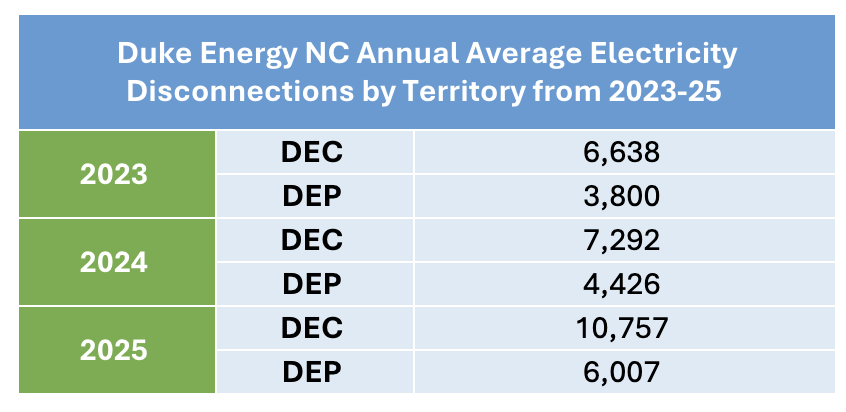
One of the most predominant issues of the day is rising electricity prices, especially in North Carolina. The state’s residential customers have seen a more than 27% increase in electricity rates over the past 10 years. Due to these significant rate increases, the average number of North Carolinians that have been disconnected from utility service due to non-payment has also increased drastically across both Duke Energy Carolinas (DEC) and Duke Energy Progress (DEP) territories over the past two years (see the table below for specific numbers). Duke Energy recently filed its latest Multi-Year Rate Plan (MYRP) with the NC Utilities Commission (NCUC) and requested a 15% increase in rates for DEC customers and a 15.1% increase for DEP customers. This represents about $1.73 billion in additional requested revenue for the period of 2027-28. While the utility still needs to go through a months-long regulatory proceeding to receive approval for these rate hikes, this evidence indicates that skyrocketing electricity bills are an inevitability without much needed intervention.
One of the major drivers of escalating electricity prices is the volatility of the cost of fuel for natural gas facilities. As natural gas expands into the global marketplace, the price volatility for natural gas will further increase, and the certainty of delivering safe and reliable electric service to customers at an affordable price will decrease. This is particularly true in North Carolina as Duke Energy’s most recent Carbon Plan Integrated Resource Plan includes 12 proposed natural gas plants across the Carolinas system through 2040. Recent trends in natural gas prices demonstrate that this market can change drastically over a short period of time; the Henry Hub natural gas price rose from $2.03/MMBtu in 2020 to $6.45/MMBtu in 2022, before dropping back down to $2.54/MMBtu the next year. According to testimony from Duke Energy filed in the most recent DEP Fuel Rider proceeding, the Henry Hub price is projected to increase yet again to $4.07/MMBtu this year. In addition to global market pressures on price volatility, natural gas supply and costs are extremely susceptible to factors like severe weather events and international geopolitical events like war.
The very real effects of international conflict are on full display right now. The U.S. – Israeli war on Iran, launched in late February, has effectively closed the Strait of Hormuz – the world’s critical energy chokepoint – to tanker traffic. The scale of disruption is historic: according to the International Energy Agency’s latest Monthly Oil Market Report, the conflict is creating “the largest supply disruption in the history of the global oil market.” The same blockade that triggered this oil shock has also knocked out roughly 20% of global LNG supply, as Qatar — the world’s second-largest LNG exporter — was forced to halt production. LNG prices have surged since the war began, and analysts expect prices to remain elevated for as long as the Strait remains compromised. These are forces well beyond the control of North Carolina’s electric utilities, yet those costs will ultimately land on ratepayers.
“Every gas price spike teaches the same lesson: fuel dependence creates vulnerability,” said NCSEA’s Chief of Policy Strategy, and Innovation Josh Brooks. “Whether it’s gasoline for your car or natural gas for power plants, tying your costs to volatile commodity markets means a lot of risk exposure for ratepayers who are already experiencing significant increases in rates.”
Aside from the fallout from the current international conflict, North Carolina ratepayers have already been experiencing the harmful impacts of fuel price volatility. Between 2017-23, EQ Research found that fuel costs were responsible for 86.3% of the increase in bills in DEC territory and 47% of the increase in DEP territory. Primarily, this is due to North Carolina state law that allows Duke Energy to pass through 100% of fuel costs to ratepayers. In practice, this state law has enabled the utility to recover billions of dollars in prudently incurred fuel costs from its customers. However, it has further enabled utility customers to assume 100% of the risks associated with fuel price volatility— regardless of the source of that volatility. For example, in the 2023 DEC Fuel Rider proceeding, the utility reported a $998 million under-recovery of fuel costs and subsequently received approval to recover these costs from customers. Winter Storm Elliott and conflicts overseas contributed to this significant under-recovery. DEC customers are still paying for this under-recovery in addition to fuel costs from the year prior. It is critical that policymakers consider solutions to insulate ratepayers from this volatility in the cost of fuels.
Fortunately, there is already a solution available and being implemented by numerous states: fuel cost-sharing. Fuel cost-sharing is a policy tool that addresses the core problem of misaligned incentives between customers and the utility. Since Duke Energy can recover 100% of its prudently incurred fuel costs from North Carolina customers, the utility is not properly incentivized to reduce its spending for natural gas or improve its operational efficiency regarding how it dispatches its fuel-based generation assets. In order to incentivize the utility to reduce costs, fuel cost-sharing transfers a portion of the risk to the utility. This means that the utility bears a share of any cost overruns. However, well-designed fuel cost-sharing mechanisms can also represent an earnings opportunity to the utility to share in any savings triggered by improvements in its procurement and operational practices that result in fuel costs below forecasted levels. Fuel cost-sharing mechanisms will benefit customers as they will pay less for fuel through their electricity bills in either scenario. While it has already been implemented in a number of states, North Carolina has not adopted this mechanism.
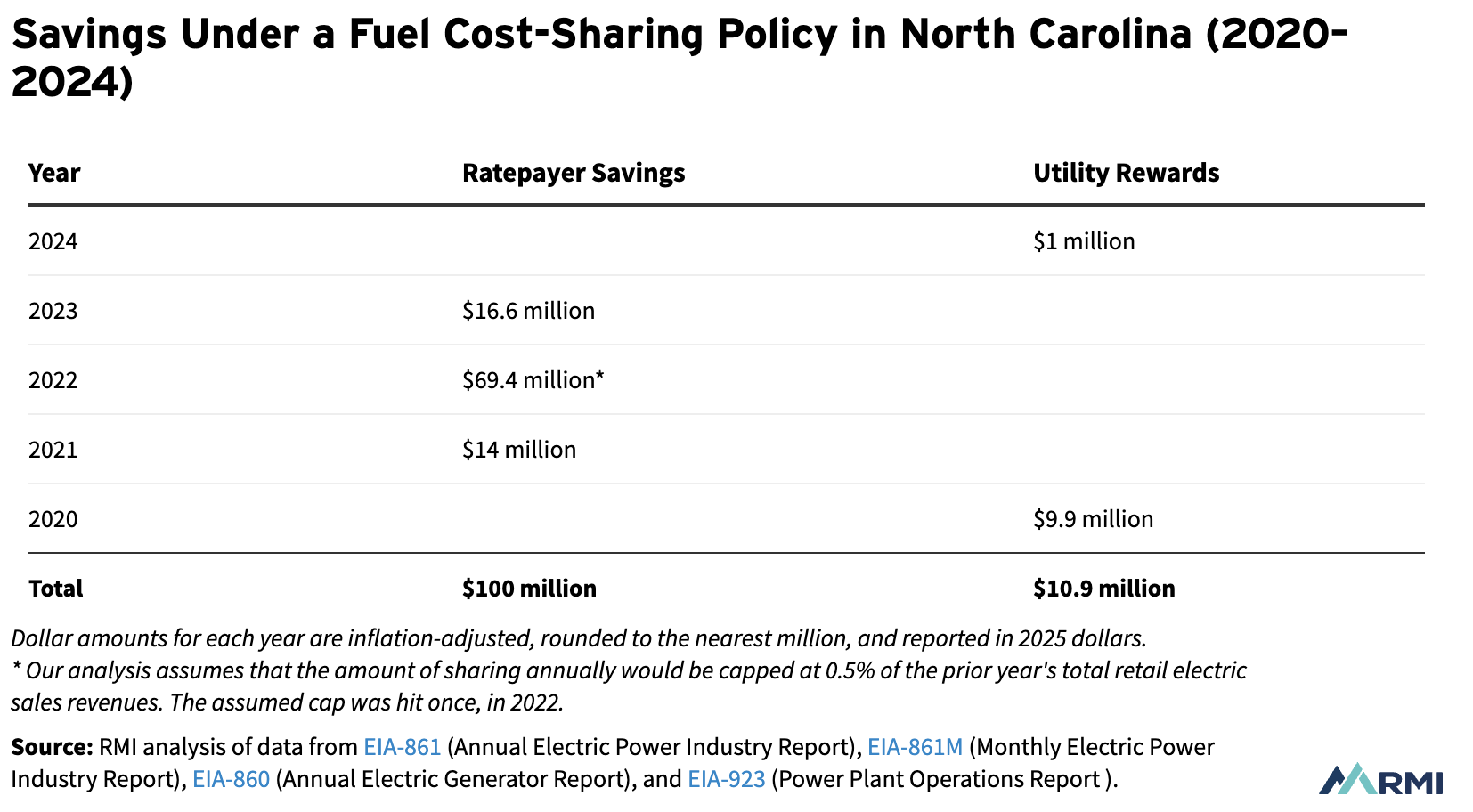
RMI recently produced an analysis showing how fuel cost-sharing can bring significant savings to North Carolinians and improve utility accountability without threatening utility revenue streams. While the specific portion of fuel costs that is shared by the utility varies by state, this analysis utilized a 10% sharing rate and a sharing cap that limited the total financial stake for the utility to 0.5% of the prior year’s total retail electric sales. If cost-sharing had been in place from 2020 to 2024, RMI found that North Carolina customers could have seen $89 million in cumulative savings — a majority of the savings in 2022 when customers would have been shielded from significant volatility. When fuel costs were higher than expected, the amount of savings increased for customers (subject to the 0.5% cap of prior retail sales, which minimized the risk for the utility’s bottom line). Conversely, when fuel costs were lower than expected, the utilities got to share in the benefits. In 2024, the utility could have earned an additional $1 million if fuel cost-sharing had been in place. Overall, fuel cost-sharing can be mutually beneficial for North Carolinians and its utilities given its ability to address energy affordability and reward the utility for making decisions that lower fuel costs.
Looking outside of North Carolina, nine states have already implemented a variation of fuel cost-sharing to the benefit of all ratepayers. Most states utilize symmetrical sharing percentages regardless of how close fuel costs are to the expected amount, but some have implemented a variable fuel cost-sharing percentage that depends on how close fuel costs are to the forecasted value and whether fuel costs are higher or lower than anticipated. In Wyoming, Rocky Mountain Power contributes 20% toward fuel costs in a straight-sharing approach. Missouri has a 5% sharing percentage for Ameren, Evergy, and Liberty utilities. Nevada passed legislation last year that requires the Public Utilities Commission of Nevada to investigate the potential for fuel cost-sharing and submit a report by July 1, 2026. (For more examples of fuel cost-sharing in other states, check out RMI’s Strategies for Encouraging Good Fuel-Cost Management and Electricity Affordability Toolkit Fuel Cost-Sharing page.)
In this era of rising electricity bills, fuel cost-sharing is a vital tool for protecting ratepayers from paying the price for market conditions outside of their and their electric utility’s control. In addition to shielding ratepayers from a portion of fuel cost risk, fuel cost-sharing motivates the utility to consider deploying greater amounts of clean, fuel-free energy resources that do not depend on global energy markets. The increased deployment of fuel-free resources paired with fuel cost-sharing can effectively reduce customers’ exposure to price swings associated with natural gas.
NCSEA recently advocated for fuel cost-sharing in the 2025 DEC and DEP Fuel Rider proceedings. Through expert witness testimony submitted in both the DEC and DEP hearings, NCSEA recommended that the NCUC direct all regulated utilities in the state to conduct a study to assess a range of fuel cost-sharing mechanisms and that the fuel costs associated with any new or upgraded fuel assets are shared between the regulated utilities and customers. Ultimately, the commission concluded in its order that it “does not find the implementation of a study or cost-sharing mechanism appropriate in the context of a fuel proceeding absent a statutory directive with such a requirement.” Even though these proposals were not approved in the most recent Fuel Rider proceedings, NCSEA recognizes the urgency of advancing fuel cost-sharing at both the NCUC and General Assembly as it is a commonsense solution that can improve the quality of life of all North Carolinians. NCSEA will continue to advocate for this policy mechanism in venues such as the 2026 Multi-Year Rate Plan and Performance Based Regulation proceedings.