
As the first milestone in the 2026 Carbon Plan update, Duke Energy filed its proposed Carolinas Resource Plan on October 1, 2025, with the NC Utilities Commission (NCUC).
The Carbon Plan Integrated Resource Plan (CPIRP) process was initially established through House Bill 951 (2021) and required Duke Energy to reduce carbon emissions from power generation 70% by 2030 and achieve net-zero carbon emissions by 2050. However, the process was altered drastically by the recent passage of Senate Bill 266 (2025), which eliminated the 2030 interim carbon emissions reduction requirement. The 2050 carbon neutrality mandate remains in place, but this transformational shift in energy policy will have a major impact on the 2026 Carbon Plan process, as Duke Energy is no longer required to comply with the interim carbon reduction requirement when doing its modeling. To find out more about how this law will impact state energy policy, take a look at NCSEA’s analysis of SB266.
Additionally, the passage of the federal reconciliation bill back in July is dramatically impacting the entire clean energy industry due to the elimination of a wide range of clean energy tax incentives. Overall, the policy changes enacted in 2025 will factor heavily into what North Carolina’s energy mix looks like from 2026 onward.
The exponential growth in the number of new large electric load customers such as data centers and manufacturing facilities is another significant factor in state-level energy resource planning. Last November, Duke Energy filed its Fall 2025 Semi-Annual Update Report on Large-Load Customer Additions in Advanced Stages of Development within the Carbon Plan docket (E-100 Sub 207). While the initial Spring 2023 Load Forecast included eight advanced development projects with 1,350 MW of full load peak demand, the latest update includes 38 projects in the queue and a peak demand of 5,610 MW. Given this upward trend is likely to continue, large load additions will continue to be a critical component of resource planning.
Origins of the Carbon Plan
The Carbon Plan process is arguably the most important venue for energy planning in the state because it determines North Carolina’s future mix of power generation. HB951 delegated decision-making for the CPIRP to the NCUC and directed Duke Energy to “achieve compliance with the authorized carbon reduction goals” within its resource planning from 2021 onward. Additionally, the CPIRP incorporates a least-cost planning approach and ensures that “resource changes maintain or improve upon the adequacy and reliability of the existing grid.” For more details on the 2022 Carbon Plan Order and the 2024 Carbon Plan Order, check out NCSEA’s coverage of the proceedings.
Duke Energy’s 2025 Proposed Carolinas Resource Plan
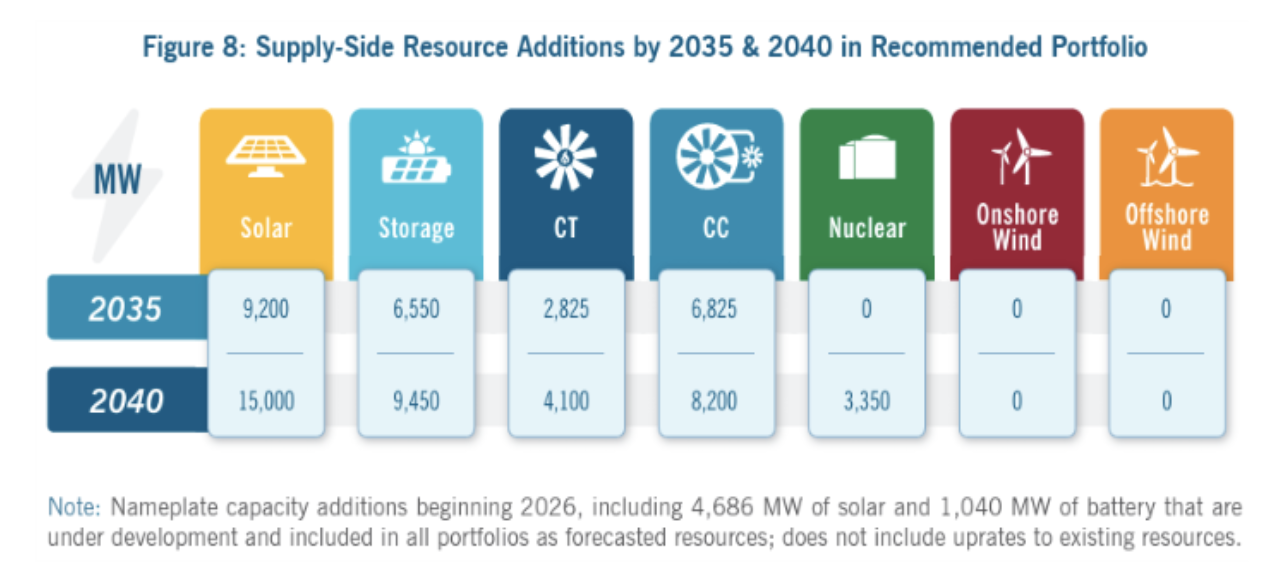
Diving into the resource capacity amounts within Duke Energy’s proposal, the utility presented the following additions in its Recommended Portfolio:
Source: Duke Energy 2025 Carolinas Resource Plan, Executive Summary, Page 13
Natural Gas
Duke Energy did not change the amount of proposed combined cycle (CC) power plants from its previous goal of five CCs by 2033 (amounting to 6,825 MW), but the utility did increase the proposed capacity of combustion turbine (CT) power plants by 700 MW. This adds as many as seven planned CTs with a total capacity of 2,825 MW by 2032. By 2040, Duke Energy is planning on increasing these amounts to 4,100 MW of CTs and 8,200 MW of CCs. This significant buildout of new gas plants presents affordability risks due to the general volatility of gas prices and the significant fuel costs that are passed through to ratepayers. The utility is also proposing Enhanced Liquefied Natural Gas (ELNG) storage facilities at future CC sites as possible solutions to address fuel price volatility and supply concerns. To date, ELNG facilities are not broadly deployed by utilities across the United States, and the cost of such assets remain unclear.
Further, the utility maintains its strategy of leveraging hydrogen and carbon offsets to reduce carbon emissions from natural gas assets in compliance with the pathway to net-zero carbon emissions by 2050. However, the utility’s near- and immediate-term actions are focused on refining this hydrogen technology and potentially developing a pilot engineering study, demonstrating that hydrogen is not yet commercially viable at scale (see page 21 of Chapter 4: Execution Plan for the full list of actions). Given that a recently released map from the U.S. Geological Survey shows that North Carolina also has limited geographic potential for hydrogen development, this reliance on hydrogen introduces implementation risks and jeopardizes the 2050 net-zero mandate.
Coal
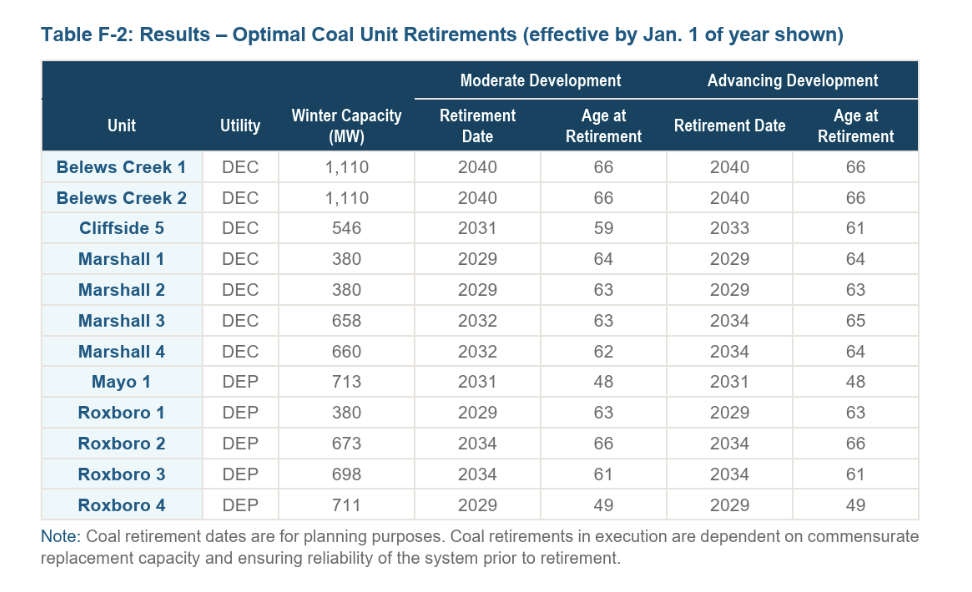
After receiving Commission approval for the coal retirement schedule in the 2023 Carolinas Resource Plan, Duke Energy is now requesting a delay in retirement dates for select coal units. In particular, the utility carried out an updated coal unit retirement analysis and proposed the following revised retirement dates:
Source: Duke Energy 2025 Carolinas Resource Plan, Appendix F, Page 12
As justification for extending certain retirement dates, Duke Energy cites the need to employ a replace-before-retire approach, which it defines as building new replacement energy resources before retiring any coal units to maintain grid reliability. Further, the utility notes that the federal government’s recent actions to ease restrictions on coal are part of its consideration as well. This postponement of coal retirement dates makes it more difficult to achieve the 2050 net-zero goal while also obligating ratepayers to pay for more expensive power for a longer period of time. While anticipated load growth necessitates widespread expansion of generation resources, NCSEA agrees with the utility’s assertion that there are “more efficient, flexible, and cost-effective resources” available than coal to meet this need (see page 1 of Appendix F: Coal).
Solar
In a shift from the previous Near-Term Action Plan (NTAP), Duke Energy decreased the annual MW/year of solar within its planning. While the utility’s previous procurements of 4,686 MW of solar from 2022-25 are included in all modeling scenarios, they are now only soliciting 1,700 MW through the 2025 RFP before reducing the annual level to an average of 770 MW per year from 2026 to 2028. In total, this represents approximately 2,300 MW of solar and solar plus storage to be pursued through the 2025-28 request for proposals (RFPs) process with targeted in-service dates between 2030-34. In the long-term, Duke Energy intends to acquire 9,200 MW of solar by 2035 and 15,000 MW by 2040.
“Given that solar is the fastest, most cost-effective route to adding electrons to the grid, NCSEA is disappointed by the proposed decrease in annual additions for this resource,” said Josh Brooks, NCSEA’s Chief of Policy, Strategy, and Innovation. “At a time when the utility is anticipating exceptional load growth and requesting a massive increase in electric rates, the responsible thing to do would be to design a system for the needs of the state. Such a system would scale quickly, offer maximum flexibility and reliability, and enable prosperity for all of North Carolina. A survey of available solutions clearly identifies solar as the backbone to such a system.”
Storage
Duke Energy included 5,600 MW of both standalone battery storage and battery storage paired with solar in its 2025 NTAP, representing an increase of 2,900 MW from the prior CPIRP. Approximately 1,270 MW of the 5,600 MW total is intended to be paired with solar (including 720 MW in the 2025-28 solar and solar paired with storage RFPs), while the remaining 4,330 MW will be standalone storage. Duke Energy discusses how storage is consistently selected across various modeling scenarios due to its “shorter development timeline when compared to other dispatchable capacity resources” (see page 23 of Chapter 3: Portfolio Development & Evaluation). Despite the clear advantages of battery storage, the utility currently limits the pathways available to procure standalone storage in the most cost-effective way. “The underutilization of an open, competitive procurement process that enables independent developers to build storage projects and transfer their ownership to Duke leaves cost savings on the table,” said Justin Somelofske, NCSEA’s Regulatory Affairs Manager. “To take full advantage of North Carolina’s battery storage potential and advance least-cost resource planning, the utility should consider a public procurement process moving forward.”
Long-Lead Generation Sources: Wind and Nuclear
Shifting over to long-lead generation resources, Duke Energy did not include any procurement targets for nuclear or offshore wind in its 2025 NTAP and indefinitely delayed the addition of the Bad Creek II pumped-hydro storage unit. Since the NTAP planning period runs from 2026-28, this is not surprising given that such long-lead generation resources take significantly longer to design, develop, and deploy compared to other energy resources. Zooming in on wind and pumped-hydro storage, the utility’s decision to not include any of these resources within its 15-year Base Planning Period relates to 1) the uncertainty surrounding development costs for wind resources due to the elimination of federal tax credits and 2) the prioritization and acceleration of other near-term projects while preserving optionality and reducing network upgrade costs (see Appendix H: Renewables & Energy Storage). Duke Energy maintains that wind development and pumped-hydro storage are available resource options to be developed later in the 2040s, but there are no specifics mentioned in terms of next steps for their development.
Looking at Duke’s plan for nuclear energy, the Company emphasizes that it is the key replacement resource when planning coal retirements. While the 2025 NTAP includes optionality for development activities for either small modular reactors (SMRs) or large light water reactors (LLWRs), the target in-service date for 3,351 MW of new nuclear is now 2037. Duke further projects the inclusion of new advanced nuclear facilities in the 2040s. In the meantime, Duke Energy is in the process of obtaining subsequent license renewals (SLRs) for each of its existing nuclear units to extend their operational lives by an additional twenty years and is carrying out extended power uprates to increase the total capacity of the nuclear fleet.
Takeaways and Next Steps
Overall, Duke Energy’s proposed 2025 Carolinas Resource Plan fails to take full advantage of readily available, least-cost generation resources like solar and battery storage that can add electrons to the grid rapidly and reliably serve load growth. Even without any government subsidies, clean energy has proven itself to be the cheapest method to access new power. In fact, the levelized cost of energy (measured in $ per MWh) of large-scale solar has been lower than all other energy resources since 2015. Duke’s plans to expand CT and CC capacity into the 2040s and depend on transitioning to hydrogen to reduce emissions puts them at risk of not meeting the 2050 net-zero carbon emissions statutory target. Above all else, this puts ratepayers at risk of footing the bill for expensive generation assets instead of employing a true least-cost approach to resource planning.
In terms of next steps, intervenor testimony for parties that are formally intervened in the Carbon Plan docket is due 180 days after Duke Energy filed its proposal, which is on March 30, 2026. Public hearings to receive additional testimony have also been scheduled in early 2026 at the following locations:
- Durham County Courthouse – Wednesday, February 4, 2026, at 7 p.m.
- New Hanover County Courthouse – Wednesday, March 4, 2026, at 7 p.m.
- Virtual Webex Meeting – Monday, March 16, 2026, at 6:30 p.m.
- Buncombe County Courthouse – Tuesday, March 17, 2026, at 7 p.m.
- Mecklenburg County Courthouse – Wednesday, March 18, 2026, at 7 p.m.
After Duke Energy files any relevant rebuttal testimony and exhibits on May 14, the NCUC will convene the evidentiary hearing on June 9, 2026. Looking ahead, the 2026 CPIRP Order is required to be issued by December 31, 2026.