
Synapse analyzed ratepayer bill impacts from solar installations driven by Senate Bill 3 (SB3) and the Public Utility Regulatory Policies Act (PURPA) in North Carolina since 2007 and forecasted savings through 2035.
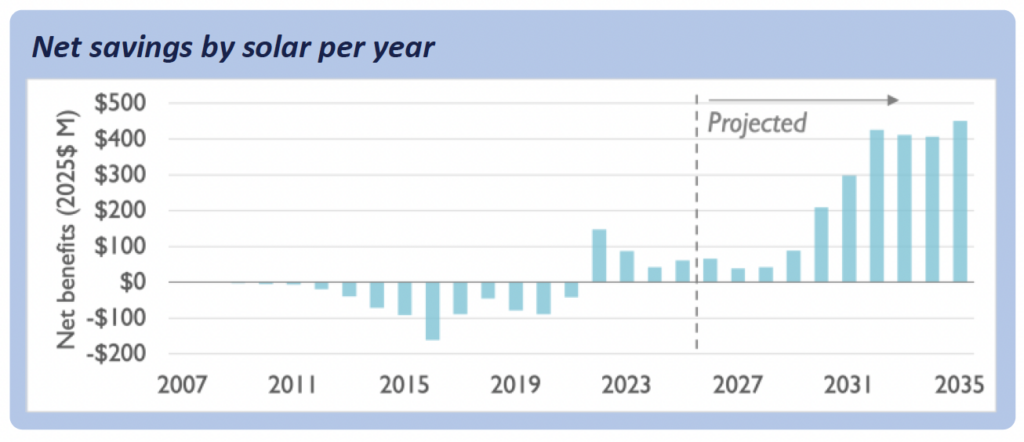
NCSEA commissioned Synapse Energy Economics, Inc. to develop a study analyzing the value solar energy resource additions have brought to North Carolina customers and the electric system and forecasting the potential for additional value in the future. Using NCSEA’s Renewable Energy Database and publicly available information, this analysis first looked at the historical customer bill impacts driven by North Carolina’s Senate Bill 3 (2007) and the Public Utilities Regulatory Policies Act of 1978 (PURPA) — the two statutes that have enabled the development of the solar energy market in the state. The study concludes that between 2007 and 2021 as solar was scaling up these assets represented a net cost to customers. However, once solar energy achieved economies of scale in 2022, the resource represented a net savings to customers. Those savings are projected to continue through 2035, for all customer classes, as solar energy can help stabilize and offset the fuel price volatility for natural gas and coal energy resources.
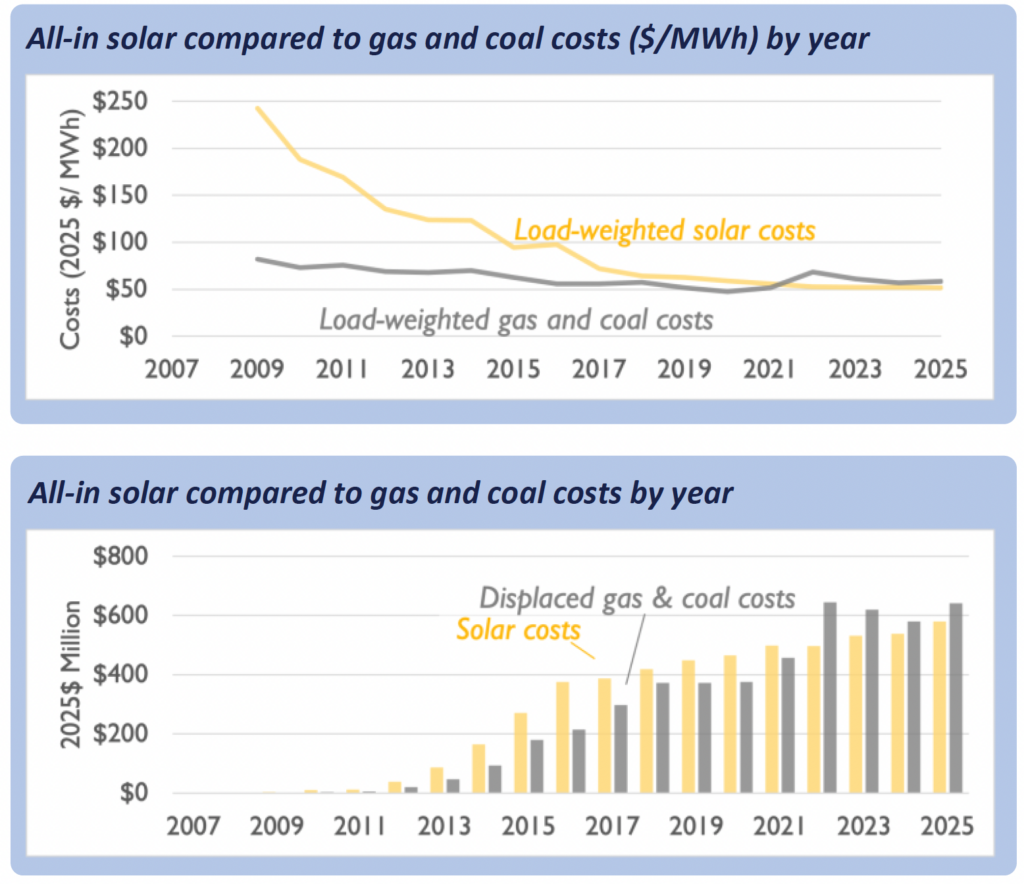
Specifically, between 2007 and 2025, approximately 6.1 gigawatts (GW) of new solar energy resources were deployed in North Carolina. The study concludes that through 2025, the total cost to deploy those 6.1 GW of solar was $5.3 billion. When comparing the total costs of solar energy to the costs of the gas and coal displaced by solar energy, the costs of solar outweighed the costs of displaced gas and coal. In other words, in total, solar energy has represented a net cost of $401 million across all customer classes.
However, since 2022, solar energy resources have achieved economies of scale and have been the cheaper, more cost-effective option for electric generation. Since 2022, solar energy has saved customers a total of $339 million compared to the gas and coal generation it displaced. This is because growing reliance on gas generation has exposed customers to greater price volatility and costs ultimately borne by customers. In the last four years of the study’s analysis (2022 – 2025), for every $1 spent on solar energy, customers saved $1.16. For residential customers, solar energy produced an average net savings of $38 million per year, equivalent to $8 of savings per residential customer per year. Across all commercial and industrial customers, solar energy has produced an average net savings of $47 million per year.
These findings support the conclusion that solar energy has not been a driver of recent rate increases but instead is creating downward pressure on rates.
Looking forward through 2035, solar energy is projected to continue saving all customer classes money. Residential customers are projected to save an average of $77 million annually, equivalent to $13 of savings per customer each year. Across all commercial and industrial customers, solar may produce an average net savings of $167 million per year. Further incremental additions of solar on an annual basis over the next decade could lead to a total of $2.4 billion in ratepayer net savings.
Solar has become cost-effective over time, with ratepayer savings starting in 2022.
- Over 2007–2025, solar had net costs of $401 million, becoming cost-effective in 2022
- As solar installations grew starting in 2009 to over 6 GW by 2025, the cost of solar decreased on average by five percent every year
- Generation from solar increased, displacing gas and coal generation, which has been subject to increased price volatility due to supply chain and geopolitical factors
- Since 2022, solar has saved ratepayers $339 million and has been cheaper per MWh than the gas and coal that would have taken its place
- This translates to annual savings of $38 million across residential customers and $47 million across commercial and industrial (C&I) customers
Solar may save ratepayers $2.4 billion over the next 10 years.
- To meet Duke Energy’s Advancing Development load forecast and an extension of the Clean Energy and Energy Efficiency Portfolio Standard (CEPS), utilities would need to procure 4 GW of new solar per year
- We found that procuring this solar would be cheaper than the gas and coal alternative by $2.4 billion dollars over the next 10 years
- Our analysis indicates that a smaller amount of solar built would also be cost-effective
- Adding 4 GW of solar per year may save residential customers $77 million and C&I customers $167 million annually
NC Ratepayer Savings from Solar: One-Pager
View and DownloadNC Ratepayer Savings from Solar: Full Report
View and DownloadBackground: North Carolina's Solar policies
PURPA
Requires utilities to purchase energy and capacity from approved generators at avoided cost rates.
SB3
Created in 2007. Required North Carolina utilities to meet a percentage of retail electricity sales with renewable energy by creating a Renewable Energy and Energy Efficiency Portfolio Standard, which is now CEPS.
HB951
In 2021, North Carolina passed HB951, which requires electric utilities to achieve net-zero carbon emissions by 2050.